
A Coffey County VINE result is useful only after the named person and reporting custodian are matched. Keep that scope attached to every copied status.
Coffey County VINE Coverage
Kansas VINE through VINELink is an event and notification layer. It receives custody information from participating agencies, presents a person record, and may offer alerts for release, transfer, or another reported status change. It does not replace the sheriff's release sheet, a KDOC movement record, or a court order. A release result means release from the named reporting custodian. It does not prove that no transfer, detainer, or other custody followed.
The official Kansas VINELink interface supplies the current choices:
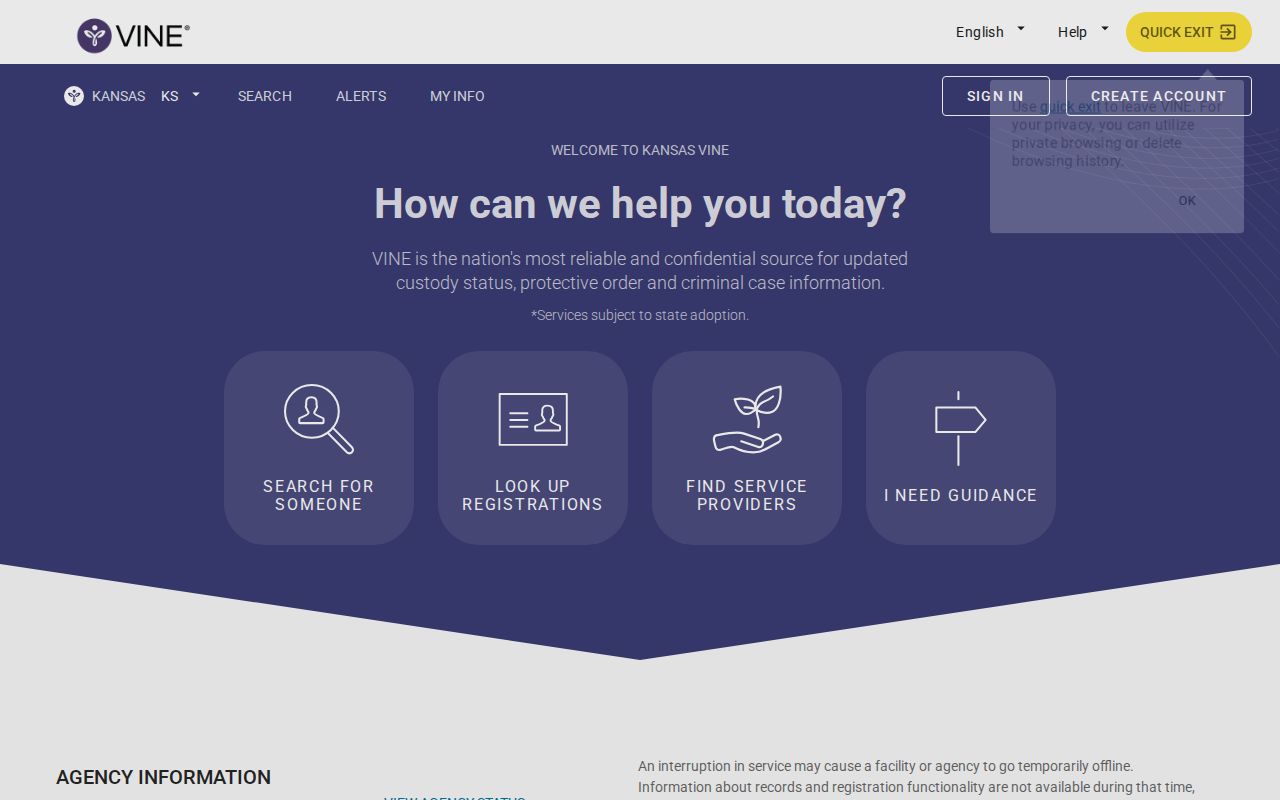
Use its live controls because agency, event, and notification options can change.
Coffey County participation must be checked inside the live Kansas agency selector before an alert is promised for a particular booking. The interface and offered events can change. Research did not force a search using an unrelated person's identifying data, so no unsupported claim is made about the exact Coffey County status vocabulary displayed today. KDOC and a local jail may contribute separate records for the same person at different points in the custody trail.
The Coffey County Sheriff's victim-resources page supplies the local resource layer. VINE supplies automated event notices. Use both according to their roles. A statewide enrollment screen alone is not proof that every Coffey County booking is available.
Search Coffey County VINE Records
Use enough information to distinguish the intended person, but do not publish private search details. A no-result is inconclusive. Spelling, an alias, a recent booking or transfer, a stale agency feed, an older release, or nonparticipating custody can all produce an empty search. The complete named-person search route, including sheriff, court, and state records, appears on the Coffey County released inmates page.
- Open Kansas in VINELink and choose the person or custody search.
- Choose the agency if the interface offers that filter. Confirm that Coffey County or KDOC appears before relying on expected coverage.
- Enter the person's name or available identification number. Try a known alias or alternate spelling when appropriate.
- Compare agency, age or birth information, identification number, and other shown details. Do not select a record based on name alone.
- Open the matched record. Copy the exact custody-status and event labels along with the date checked.
- If the record reports release, ask whether the named agency ended custody or transferred the person to another authority.
Coffey County VINE Fields
Displayed fields vary by agency and record. Treat interface wording as evidence, not as language to rewrite. “Custody status” may describe the reporting system's current state. The agency or facility identifies whose record is being viewed. An offender or booking identifier helps separate people with similar names. Event information can show a change reported to VINE, while a projected date remains different from an actual physical release.
| Field | How to read it |
|---|---|
| Name and identifier | Match both where possible; a name alone is weak identification. |
| Reporting agency | Defines which custodian supplied the status. |
| Custody status | Copy the exact label and confirm recent changes directly. |
| Facility or location | Shows the reported custodian or placement, subject to feed timing. |
| Event date | Marks a reported event, not necessarily a court-order date. |
| Notification options | Channels and events offered for that agency and record. |
The KDOC custody glossary helps with state corrections terms. “Inmate” means state confinement. “Parole” is release to community supervision under the applicable sentence structure. “Discharged” is the strongest state status showing the KDOC obligation displayed has ended. Those KDOC definitions should not be imposed on a county record that uses other words.
Register Coffey County VINE Alerts
Registration begins from a correctly matched record. Available channels commonly include email, text, phone call, or in-app notice, but only the live options should be described as available for that agency. VINE recommends using more than one method when offered. An alert is a prompt to verify, not a certified release notice. Contact the sheriff, jail, or KDOC if timing affects a safety plan or court process.
- Select the notification action on the matched person record.
- Choose the custody events offered for that agency. Do not assume an event that is absent from the screen will be reported.
- Select the available phone, email, text, or in-app channels and enter each destination carefully.
- Confirm the destination as the interface requires. An account verification code sent by email or text is separate from a notification PIN.
- Create the requested four-digit telephone notification PIN when prompted. Store it privately.
- For a phone or TTY alert, listen and enter the PIN followed by the number sign. That acknowledges the event and can stop repeat calls.
- Keep the PIN because it may also be needed to modify the registration. Never publish it.
A VINE account verification code establishes access to the account. A four-digit alert PIN acknowledges a telephone custody-event notice. Confusing these two steps can leave repeat calls active or prevent a later change to the registration. Review the registration screen before leaving it, and keep the selected agency with the alert record.
Coffey County Victim Notification
The sheriff's local resources and Kansas VINE serve related but distinct needs. The local page can route a person to Coffey County contacts and support information. VINE watches events received from participating custodians. Before registration, find the actual detention center or state agency in the selector. A general Kansas VINE page is not enough to promise a county alert.
Use multiple direct and automated channels when the matter is urgent. Alert delivery can fail because contact information changes, a phone blocks calls, an email is filtered, or an agency event is delayed. A record can also leave one custodian through transfer. Preserve the agency name, selected event, and registration date so a later discrepancy can be described precisely.
Coffey County VINE Limits
VINE does not cover federal Bureau of Prisons custody. For a sentenced federal prisoner, use the BOP Inmate Locator. A federal pretrial detainee may be under the U.S. Marshals Service and never appear as a sentenced BOP record. ICE has a separate locator for immigration custody. None should be searched without facts pointing to that system.
For county custody, the Coffey County sheriff publishes a rolling 48-hour released view. It gives a physical release timestamp but omits release reason and destination. Ask the jail or request the release sheet when those details matter. For state custody, KASPER is the durable status source and is updated each working day. VINE alerts supplement both systems.
Delay is possible in every electronic channel. A new event may not appear at once, and an old event may remain visible. Confirm the person, custodian, and time. If VINE and the originating agency disagree, preserve both access times and ask the agency that created the custody record.
Confirm Coffey County Releases
A sound confirmation uses the custody trail. First identify the VINE reporting agency. Then call or search that custodian. For a Coffey County jail event, compare the sheriff's released card and booking number, then seek the release sheet if the reason or destination matters. For KDOC, search KASPER and contact the office named in the record. Review the court docket when a bond, dismissal, sentence, or probation order explains the legal authority.
Do not infer release from silence. A VINE no-result, a roster disappearance, or a missed alert does not prove that custody ended. Each can reflect data timing, transfer, spelling, access limits, or a different authority. Direct verification closes those gaps.
The VINE inmate check is best used for a named person and a future event notification. The Coffey County release date lookup is better for understanding a projected state date and why it can change.
A recent Coffey County jail departure offers a useful verification sequence. Preserve the sheriff's booking number and release timestamp. Then inspect VINE for the reporting agency and exact event wording. If the person also has a KDOC record, compare KASPER status and facility rather than assuming the county event ended all custody. A court commitment or receiving-agency entry can show that the exit was a transfer. VINE reports its contributor's event; it does not merge every custodian into one certified history.
An older county release needs a different fallback. The sheriff card lasts only 48 hours, so the roster is the wrong archive after rollover. Request the release sheet by full name, booking number, and narrow date range. Review the Coffey County court case for a bond, dismissal, probation, sentence, or commitment order. VINE may no longer return the old event. That absence reflects lookup limits, not proof that the booking never occurred.
Keep the agency name, chosen event, registration date, and contact methods with the private registration record. Update a phone number or email through official controls. The telephone PIN should remain private because it acknowledges calls and may be needed to modify an alert. If a notice has unclear wording, open the official Kansas interface directly and contact the named custodian.
Automated notice supports a direct plan. It does not promise a specific release hour or destination. Sheriff victim resources supply local routing, while agency confirmation settles the reported custody event.
When electronic records disagree, preserve their access times. Ask which agency supplied the VINE event, then request that custodian's release or movement record. A difference can reflect feed timing. The court order may explain legal authority, while the jail or prison record supplies the physical custody event. Keeping those roles separate produces a clearer Coffey County release check.