
KDOC's public date is a record label, not a promise of a particular exit hour. When a state figure changes, compare the earlier lookup with the current KASPER entry, the signed judgment, credit history, and any later court order. Ask whether a detainer, consecutive term, or release-planning step affects physical departure. For a Coffey County jail term, use the jail's own calculation instead. That separation keeps state credit rules from being misapplied to a local stay and keeps a county release timestamp from being mistaken for final sentence discharge.
Write down who confirmed the date, which system supplied it, and when the confirmation occurred.
Coffey County Sentence Inputs
The signed judgment supplies the raw facts for a reliable state calculation. Record the offense date, severity or off-grid classification, term for each count, concurrent or consecutive direction, jail credit, and postrelease term. K.S.A. 22-3426 requires detailed judgment data in covered felony cases. A portal summary may omit part of that structure, so obtain the filed journal entry when counts or credits are unclear. KDOC then applies controlling-sentence rules to the court's terms.
Credits do not all work the same way. Ordinary good time affects the prison portion within the statutory maximum for a covered sentence. Program credit depends on defined eligibility and designated completion. Credit can be withheld or forfeited, and restoration can change an estimate. A jail-credit correction changes the computation's starting point. These events cannot be rebuilt safely from the sentence length alone.
Parole eligibility needs its own label. Under K.S.A. 22-3717, older indeterminate, off-grid, and special sentences may follow rules unlike modern determinate terms. Eligibility means the Board may consider a covered person. It does not mean release has been ordered. A parole decision still requires processing, release planning, and resolution of detainers. Many guideline sentences instead lead to mandatory postrelease supervision after prison.
Coffey County jail time follows the county record. A person may be awaiting trial, serving a misdemeanor, serving jail as a probation condition, awaiting transport, or held on several authorities. No published local rule establishes a universal earned-time percentage, standard discharge hour, or weekend substitution. Obtain the jail's calculation and ask about each hold. Applying KDOC's 15 or 20 percent caps to a county stay would produce an unsupported date.
Coffey County Release Date Meaning
A projected date is computed from the sentence information known to the custodian and the rules that apply to that sentence. It may account for jail credit, good time, program credit, concurrent or consecutive terms, and later court action. An actual release date records an event that already occurred. Parole eligibility is only the date or stage at which the Prisoner Review Board may consider a covered person. Final discharge can come later than prison release because supervision may continue in the community.
A pretrial Coffey County detainee has no sentence endpoint. Bond may be posted, charges may change, a judge may enter an order, or another agency may lodge a detainer. The sheriff's live roster cannot promise a future exit. For a county sentence, obtain the signed journal entry and the jail's time calculation. Do not apply a KDOC percentage to a person who never entered KDOC custody.
Lookup Coffey County Release Dates
Begin with custody, not with a calculator. The Coffey County jail, KDOC, a federal institution, and an immigration custodian maintain different records. A person who disappears from the county roster may have transferred rather than returned to the community. The full named-person trail is available through the Coffey County released inmates search.
- Check the Coffey County sheriff roster to determine whether the person is in county custody or appeared in the recent 48-hour released view.
- For a KDOC sentence, search KASPER by name or KDOC number and match identifiers.
- Copy the exact date label. KDOC materials describe an anticipated release date, while the live record may use “Earliest Possible Release Date.”
- Open the Coffey County court case and obtain the signed journal entry for the term, jail credit, consecutive structure, and postrelease duration.
- For a county term, call the jail at 620-364-3199 and ask for its time calculation and any holds.
- For a disputed state calculation, contact KDOC and give the KDOC number, date label, and access date.
Coffey County KASPER Date Fields
KASPER covers people associated with KDOC-funded or operated programs, including persons incarcerated, under post-incarceration supervision, or discharged. It is not a county booking archive. The public record may contain a KDOC registration number, photograph, conviction and case information, facility movements, supervising office, custody level, and an anticipated release field. It updates each working day, so preserve the lookup date.
| Record item | Use |
|---|---|
| Current status | Distinguishes inmate, parole, discharged, and other KDOC labels. |
| Earliest Possible Release Date | A conditional state date, not a guaranteed exit. |
| Sentence begins | One input to computation, subject to credit and sentence structure. |
| Conviction county and case | Connects the KDOC record to the signed court judgment. |
| Facility or supervision office | Identifies the office that can verify current state status. |
KASPER can be searched by last, first, and middle name, alias, KDOC number, State ID number, birth date, conviction county, institution, and supervision type. Coffey is available as a conviction county. A date on the wrong person's record is worse than no result, so match the identifiers before copying it.
Kansas Good-Time Date Rules
K.S.A. 21-6821 sets maximum good-time credits for covered Kansas sentences. For the ordinary post-July 1, 1993 category, a 15 percent maximum yields the familiar 85 percent arithmetic only when all available credit is earned and kept. Certain nondrug severity levels 7 through 10 committed on or after January 1, 2008, and qualifying drug categories can have a 20 percent maximum, which can yield 80 percent arithmetic. Those figures are not universal release promises.
Off-grid, older indeterminate, mandatory-minimum, consecutive, and specialized sentences need their own analysis. Program credit is separate and applies only to eligible people and approved completion. Discipline can cause credits to be withheld or forfeited. The KDOC Article 6 regulations address performance, conduct, release planning, adjustment, and credit administration.
A sound state computation begins with the signed judgment: offense date, severity level, term, concurrent or consecutive order, jail credit, and postrelease term. KDOC then applies controlling-sentence rules, earned credit, forfeiture or restoration, detainers, and later orders. This is why a single sentence length cannot be converted into a reliable date without the actual case data.
Coffey County Date Changes
Several lawful events can move or qualify a displayed date. Some change the arithmetic. Others prevent physical release even when the sentence calculation reaches an endpoint.
| Factor | Possible effect |
|---|---|
| Credit earned or restored | May advance an eligible computed date. |
| Discipline or forfeiture | May reduce retained credit and move a date later. |
| Corrected court order | Can change term, jail credit, or sentence structure. |
| Consecutive sentence | Adds controlling time that a single count does not show. |
| Detainer or hold | May cause transfer or continued custody after one term ends. |
| Board action | Can grant, pass, continue, rescind, or otherwise affect covered parole. |
| Release planning | Can affect processing before a lawful state release. |
A parole grant is not a release timestamp. Conditions, a detainer, rescission, or another custodian may intervene. Likewise, a county court order records legal authority, while the sheriff records the physical departure. Keep both dates when they differ.
Coffey County Jail Calculations
A county detainee may be pretrial, serving a misdemeanor sentence, serving jail time as a probation condition, awaiting KDOC transport, or held for several authorities. No Coffey County publication was found that establishes a local earned-time percentage, a standard discharge hour, or a Friday substitution for a weekend endpoint. Do not invent those rules.
Read the journal entry for ordered days and credit. Ask the jail for its time calculation, holds, and recorded release authority. The Fourth Judicial District court record can explain bond, probation, dismissal, time served, or commitment, but it does not replace the sheriff's actual release timestamp. K.S.A. 22-3426 requires detailed judgment information in covered cases, including sentence and supervision duration, concurrent or consecutive structure, and incarceration credit.
Confirm Coffey County Release Dates
For a state prisoner, copy the KASPER label and call KDOC at 785-296-3317 when the computation is disputed. For a county detainee, call the Coffey County jail and seek the underlying calculation or release sheet. For a legal term or credit dispute, obtain the filed journal entry from the court. Each office answers a distinct part of the question.
Register through the VINE inmate check when a participating record offers a custody-event notice. Alerts can lag and do not certify a release. Verify an alert directly with the reporting agency. A past sheriff release card can confirm that the county recorded an exit, but it cannot show a projected state date or final discharge from supervision.
Record the source, label, and date checked. Avoid shortening “Earliest Possible Release Date” to “release date.” Precision protects against a common error: treating a conditional state calculation as a guaranteed day and time at the jail door.
Coffey County Date Disputes
A disputed state date should be framed as a records question. Give KDOC the registration number, exact KASPER label, sentence case number, and date viewed. Ask for the sentence-computation or movement record to the extent public. KDOC's main office is at 714 SW Jackson, Suite 300, Topeka, Kansas 66603. Its general telephone is 785-296-3317, and Records Division is 785-746-7470. A focused request identifies the calculation without treating a search screen as the full sentence file.
For a county calculation, ask the Coffey County jail for the custody-status log, jail-credit entry, court commitment, holds, and release sheet. If a corrected journal entry or appellate order changed the sentence, provide its case number and filing date. Court and sheriff dates can differ because one records legal authority while the other records completed release processing. Preserve both.
The Kansas good-time statute page supplies the controlling credit text:
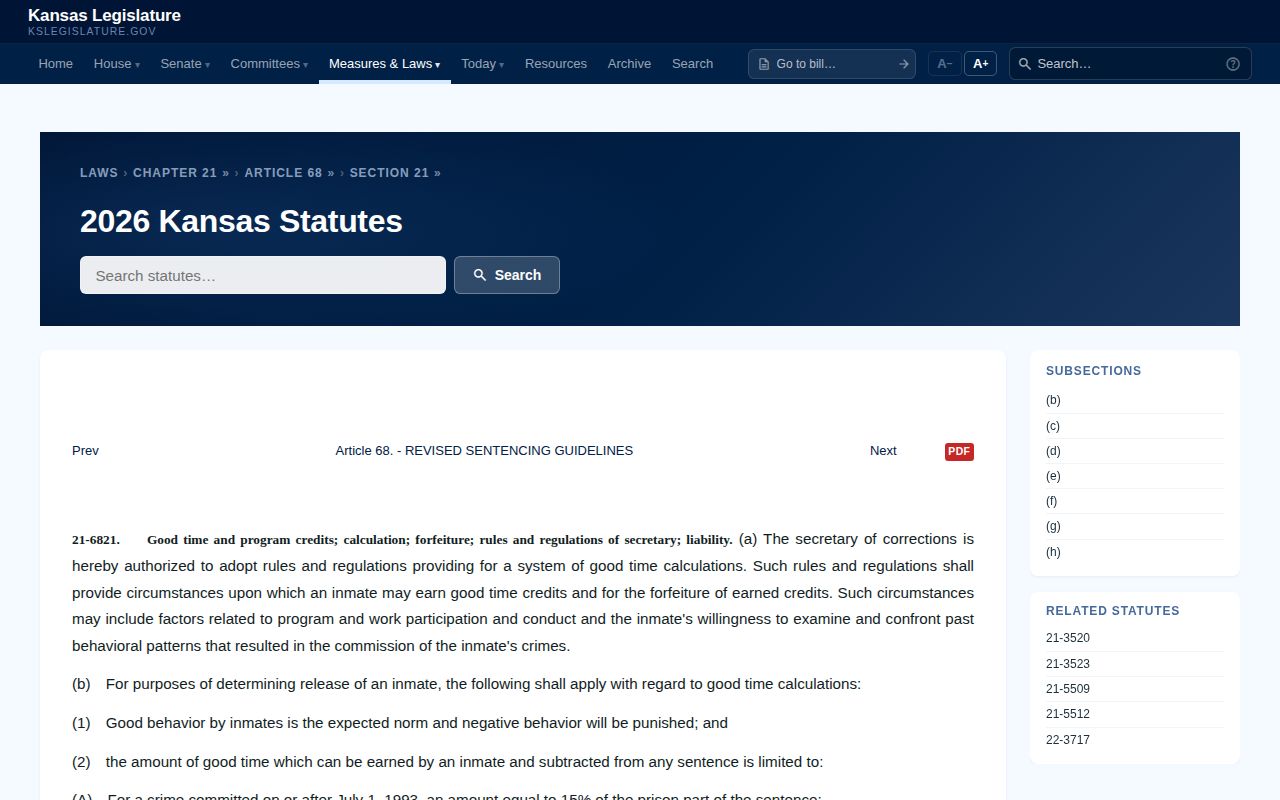
The statute must be read with sentence type and offense date. Program credit is separate from ordinary good time. A disciplinary loss, restoration, corrected order, newly aggregated term, or detainer can change the figure.