
Coffey County Supervision Types
Leaving the Coffey County jail does not establish parole, probation, or freedom from all supervision. Parole follows release from prison under an older indeterminate-sentence framework. Postrelease supervision is the community portion that follows the prison term for many Kansas guideline sentences. Probation is imposed by a court and usually allows a person to remain in the community under stated conditions. Community corrections is a more intensive local form of court supervision. The signed order and the Kansas Department of Corrections record, not the original jail charge, identify the actual structure.
These labels also mark different authorities. The Kansas Prisoner Review Board makes covered parole decisions. KDOC Community and Field Services carries out parole and postrelease supervision. Coffey County District Court controls district-court probation orders and later revocation or discharge entries. Community corrections works under the judicial system with KDOC support. A Burlington municipal case follows its municipal court record rather than the Fourth Judicial District path.
| Status | Who creates it | Best verification |
|---|---|---|
| Parole | Prisoner Review Board | KASPER status and KDOC office |
| Postrelease supervision | Kansas sentence law | KASPER sentence data and KDOC |
| Probation | Sentencing court | Journal entry and later court orders |
| Community corrections | Court placement | Court order and assigned program |
Verify Coffey County Supervision
Start with the custody path. A person released from the Coffey County Sheriff's Office Kansas Detention Center may have bonded out, received probation, completed county jail time, or transferred to another custodian. The sheriff's released card supplies a booking number and physical release time, but it does not show a release reason or supervision field. For an older release, use the court record and a narrow sheriff records request. For a person sentenced to KDOC, begin with the state repository.
- Search KASPER by full name or KDOC number. Use birth date, conviction county, and other identifiers to avoid a false match.
- Open the record. Copy its exact status, sentence, supervision, and office labels. “Discharged” is not the same as “Parole,” and “Inmate” means state confinement.
- Check the Kansas court portal for the Coffey County case. Obtain the journal entry, probation order, revocation order, or discharge order when the public docket is not enough.
- Contact the named supervising office. KASPER is updated each working day, so direct confirmation can resolve a recent change.
- If the person left the county jail recently, compare the state and court records with the sheriff's release sheet. A transfer is not a community release.
Coffey County Parole Office
KDOC assigns Coffey County to the Lawrence Parole Office in the North Region. The office serves Douglas, Franklin, Coffey, and Anderson counties. The similar name causes a real navigation error: the Coffeyville Parole Office serves Montgomery, Wilson, and Chautauqua counties, not Coffey County. Use the current KDOC parole-office directory before visiting or mailing records because assignments and contact details can change.
1800 E. 23rd Street, Suite K
Lawrence, KS 66046
785-842-2926
The Lawrence office is the right operational contact when KASPER names parole or state postrelease supervision for a Coffey County person. A probation question remains with the sentencing court or the assigned community corrections program. The Coffey County District Court is part of the Fourth Judicial District. Its clerk can route a request for the signed order, but the clerk cannot give legal advice or predict how an alleged violation will be decided.
The official KDOC Community and Field Services page shows the statewide structure:
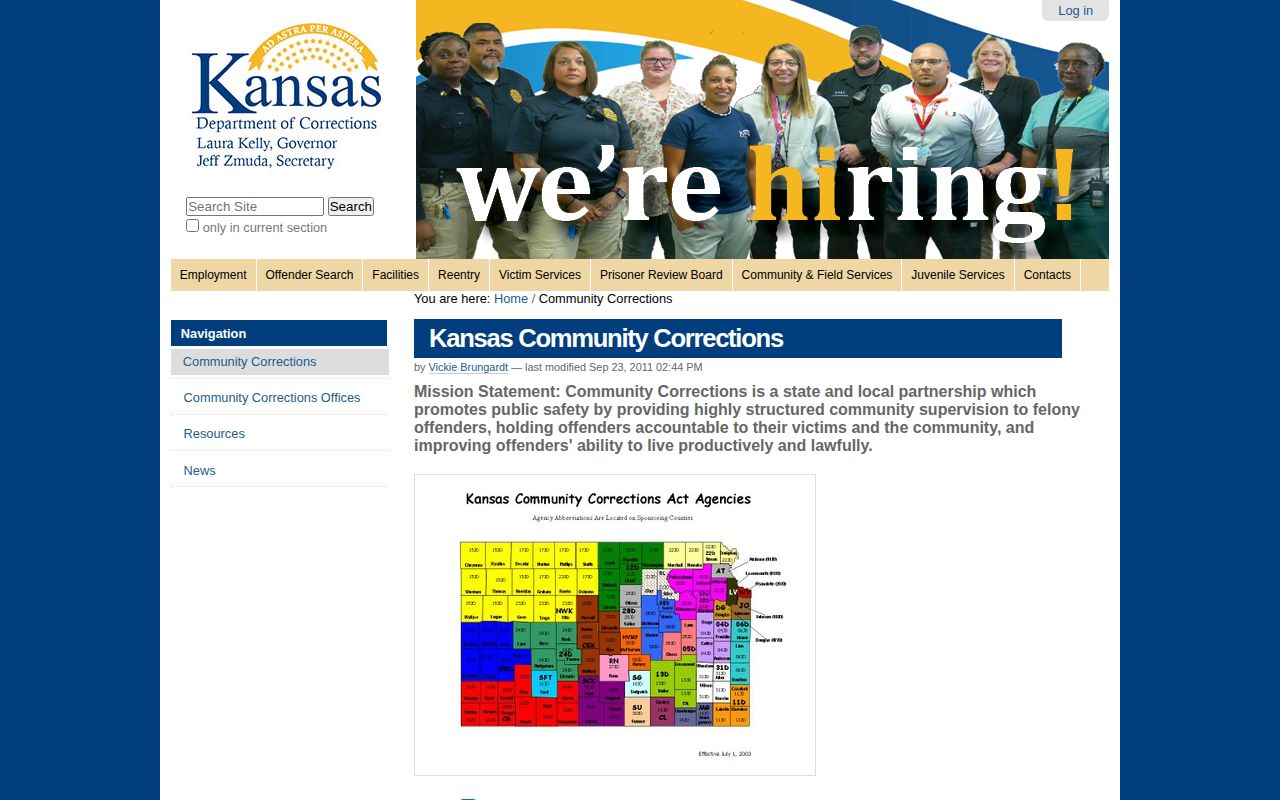
The person's record or court order still identifies the actual supervising authority.
The KDOC Community and Field Services material explains the statewide structure. KASPER has a known data limit: KDOC says community-corrections probation events after April 21, 2021 cannot be displayed during agency modernization. When that gap matters, use the court file and the specific community corrections agency rather than treating an empty KASPER field as proof that no supervision exists.
Coffey County Absconder Checks
An absconder is a person whom the supervising agency reports as having stopped required contact or whose location is unknown under the applicable supervision record. It is a status report, not proof of a new conviction, the facts behind an alleged violation, or the person's current location. KDOC maintains separate public selectors for parole absconders and community-corrections absconders. The first can be narrowed by last supervision location; the second uses administrative locations.
Match the name, date of birth, KDOC number, photograph, and supervising area. Do not act solely on a web entry. KDOC expressly warns users not to arrest anyone based on website information. Report a relevant observation through law enforcement or the statewide Absconder Tips Hotline at 785-746-7620. For a court probation warrant, inspect the Coffey County case docket and contact the responsible court or agency. VINE is designed for custody-event alerts, not as a complete supervision-warrant database.
- Absconder
- A supervision status reporting loss of required contact, subject to agency verification.
- Detainer
- A request or authority that can keep a person held for another case or agency.
- Revocation
- A formal action that may end community supervision and return a person to custody.
- Discharge
- The end of the sentence or supervision obligation shown by the responsible authority.
Coffey County Parole Decisions
The Prisoner Review Board publishes monthly public-comment schedules and offender lists. Those materials concern people approaching consideration. They are not a historical results database and are not release orders. Under the Board's process, “parole” means the person was found suitable for release subject to processing and conditions. “Continue” postpones a final decision for more information, evaluation, deliberation, or votes. “Pass” denies release for a stated period before later reconsideration.
A grant does not prove release occurred on the decision date. Release planning, a detainer, rescission, conditions, or another authority can delay or prevent the physical exit. After Board action, check the current KASPER record and request the decision notice from PRB or KDOC if the exact action matters. K.S.A. 22-3717 is offense-date and sentence specific. Many guideline determinate sentences use mandatory postrelease supervision instead of conventional discretionary parole.
Correct Coffey County Records
The sheriff's electronic form creates a useful correction path after its short release card expires. Identify the exact booking and request the booking sheet, release sheet, movement history, and release authority. If a displayed field seems wrong, state the field, the correct value claimed, the supporting document, and the exact page where the error appeared. The records instructions say the requester will receive an email for authorization before work is completed if a fee applies.
Send a KDOC data correction to the agency responsible for KASPER. Preserve the status label and access date because the repository updates each working day. For a court order, request the filed journal entry or later discharge or revocation order. This split keeps a sheriff release timestamp from being confused with the end of probation or state supervision. The broader released-person route is available on the Coffey County released inmates search.
Coffey County Supervision Discharge
Supervision ends only when the responsible authority records discharge or another lawful ending. Finishing the prison portion does not end a mandatory postrelease term. Likewise, release from the county jail does not erase a probation order or pending criminal case. KASPER's “Discharged” status is the strongest public state indication that the KDOC obligation shown has ended. A probation discharge should be confirmed through the court's filed order.
Keep the event dates separate: jail release, prison release, supervision start, and final discharge may all differ. If records conflict, retain both and ask each custodian what its date represents. That approach is more accurate than forcing the first date found into a universal “release date.”
A Coffey County court file can preserve stages KASPER does not display. The register may identify sentencing, probation conditions, an alleged violation, revocation, or discharge. Request the signed document when the docket description is too brief. Covered felony judgments include the sentence on each count, probation or postrelease duration, concurrent or consecutive structure, incarceration credit, and jail time imposed as a probation condition. Those details explain why a person can leave jail yet remain under a court order.
State records require the same care. A KASPER status is a current label within KDOC's system. It does not summarize each condition or disputed violation. Community-corrections data after the documented modernization cutoff may require a direct agency check. An empty field is not a discharge. Ask the Lawrence office about state parole or postrelease supervision only after matching the person and assignment. Ask the sentencing court or community corrections program about probation.
Final verification may use three dates: the sheriff's physical exit, the court's order, and KDOC's supervision or discharge event. Preserve each label. A person can finish county detention, begin probation, enter state custody after revocation, and later leave prison under supervision. One search cannot compress that sequence. The Coffey County release date lookup explains how a state calculation differs from these milestones.