
Coffey County 72-Hour Releases
The official Coffey County roster gateway promises a “48 Hour Release” view. It does not promise 72 hours. Thus, the web display can cover the newest two days of a three-day question, but it cannot answer the whole request. Hours 48 through 72 form an unserved interval that should be obtained through the records process.
The honest workflow is simple: do not rename the sheriff's 48-hour product. A three-day search joins two official channels. First, preserve the live cards within the available window. Second, request a date-bounded release log or release records for the older interval. This approach is especially helpful after a weekend because an event from the first day may have rolled off by the time the search begins.
Check Coffey County Three-Day Releases
Begin with a precise start and end time. A loose request for “the weekend” can be read in more than one way. Exact timestamps let the sheriff locate an existing log and let the reader separate the public 48-hour portion from the third day that is no longer displayed.
- Write down the three-day start time, end time, and the current access time.
- Open the sheriff's released list sorted by release time.
- Save the displayed name, booking number, booking time, release time, age, and charge context for matching cards.
- Identify the part of the requested range that is older than the sheriff's stated 48-hour window.
- Submit a records request for that missing interval and name the fields sought.
- Call 620-364-3199 when a current custody or transfer distinction cannot wait for a document response.
For just the most recent day, the Coffey County 24-Hour Releases page explains how to apply a one-day cutoff to the same official feed. The three-day method differs because it cannot be completed from the web view alone.
Note: Keep a copy or citation for each source and its access time when the live view and later record differ.
Coffey County Three-Day Record Fields
The sheriff's recent cards and the requested log serve related but different roles. The public card displays a defined subset. A request may seek other existing public fields, but no field should be promised unless the custodian provides it. Exempt or restricted material may be redacted.
| Field | How it supports the 72-hour review |
|---|---|
| Name and age | Help match the correct person, though neither should stand alone. |
| Booking number | Links the release to one Coffey County custody episode. |
| Release date and time | Places the recorded departure inside or outside the requested range. |
| Booking date and time | Provides the start of the local custody episode. |
| Charges and arresting agency | Add context for identity; they do not prove the final disposition. |
| Release reason or authority | Not exposed on the observed public card; request the release sheet or court order. |
| Destination or receiving agency | Not exposed on the observed card; needed to distinguish community release from transfer. |
The sheriff profile observed during research added gender, race, arresting agency, and charge detail. It did not show a release reason, destination, bond as a release field, or releasing employee. The records request should name the needed item rather than assume every field is public.
Coffey County Weekend Release Checks
A 72-hour window is most useful when no one checked the feed each day. For example, a later review may need to catch a departure that occurred near the start of a weekend. Yet Coffey County's 48-hour display will have dropped that card once it passes the stated window. The missing card does not mean the release never happened.
No official source located in the research states that Coffey County advances, delays, or otherwise changes releases for weekends or holidays. Nor was a standard release hour or a fixed web refresh cadence found. Avoid applying a practice from another Kansas jail. Use the posted timestamp for a visible event and the jail's own record for one that has rolled off.
Processing also creates distinct moments. A court can authorize release before the jail completes the physical exit. A web card may appear after that work is entered into the system. The district court explains legal authority, while the sheriff record captures county custody and the physical release timestamp.
Request Coffey County Release Logs
The sheriff's electronic records form is the official route for the third day. Ask for a date-bounded release log covering exact start and end timestamps. Requested fields may include name, booking number, booking and release timestamps, release type or authority, and destination or receiving agency where those fields exist and are public.
For a named person, add the full name, date of birth if known, booking number if known, and approximate booking and release dates. Ask for the booking sheet, release sheet, jail movement or custody-status record, and bond or release authority as needed. Electronic copies and a fee estimate can be requested. The office states that it will email for authorization before completing a request with a fee.
The Coffey County Sheriff's Office fee schedule displays posted report-copy fees and helps set expectations before a record request.
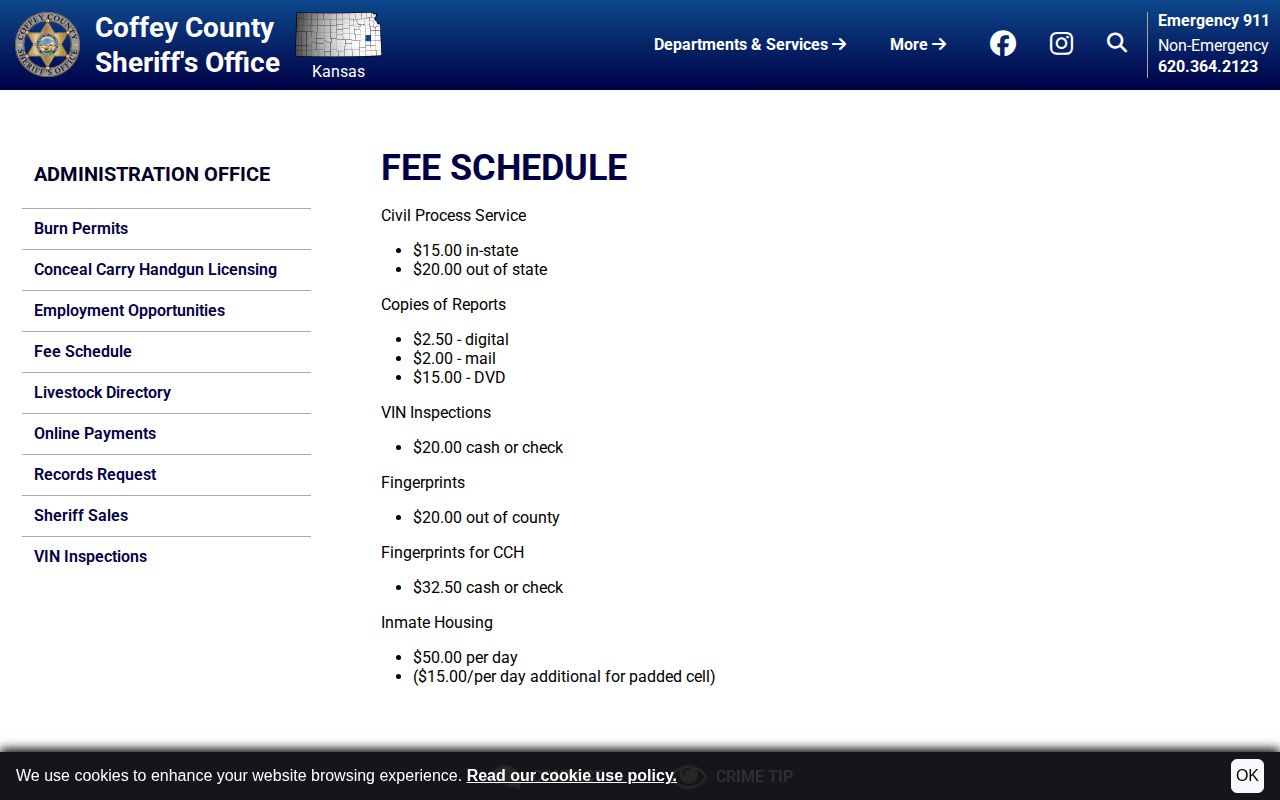
The listed report-copy prices are $2.50 digitally, $2 by mail, and $15 on DVD. They should not be described as a universal release-record price because the records page uses request-specific fee authorization.
Note: Narrow the dates and fields so the custodian can locate existing records without being asked to perform new research.
Coffey County Release Versus Transfer
A Coffey County release time marks the end of sheriff custody. It does not by itself establish entry into the community. The detention page says the jail holds people awaiting trial, serving county sentences, held on warrants or parole and probation matters, awaiting state-prison or community-corrections beds, serving municipal sentences, and held for other agencies. Those paths can end in different destinations.
- Community release
- The person leaves custody under bond, court order, sentence completion, or another lawful release event.
- Transfer
- The person leaves the Coffey County jail but remains in another agency's custody.
- Discharge
- A sentence or supervision status ends under the controlling authority; it is not a synonym for every jail exit.
- Hold
- An authority's basis to keep or receive a person. One released hold may coexist with another active hold.
A state-bound person should be checked in KASPER after KDOC intake. Federal or ICE locators are appropriate only if a release sheet, court filing, detainer, or other credible fact points to that system. Kansas VINE can provide alerts when the agency and event are available, but notification data does not replace the underlying Coffey County record.
Verify Coffey County Release Records
The jail line is the best Coffey County contact for a time-sensitive named custody check or a question about whether a departure was a transfer. The sheriff administrative line can route nonurgent office matters, while the records form fits an older event or a date-bounded log. Administrative hours govern routine records contact even though jail and dispatch functions continue around the clock.
625 Neosho Street, First Floor
Burlington, KS 66839
Jail: 620-364-3199
Non-emergency: 620-364-2123
Records questions: 620-364-2282
Administrative hours: Monday through Friday, 8:00 a.m. to 5:00 p.m.
The official sheriff contact page shows the local lines and office information used to follow up on a missing part of the three-day release range.
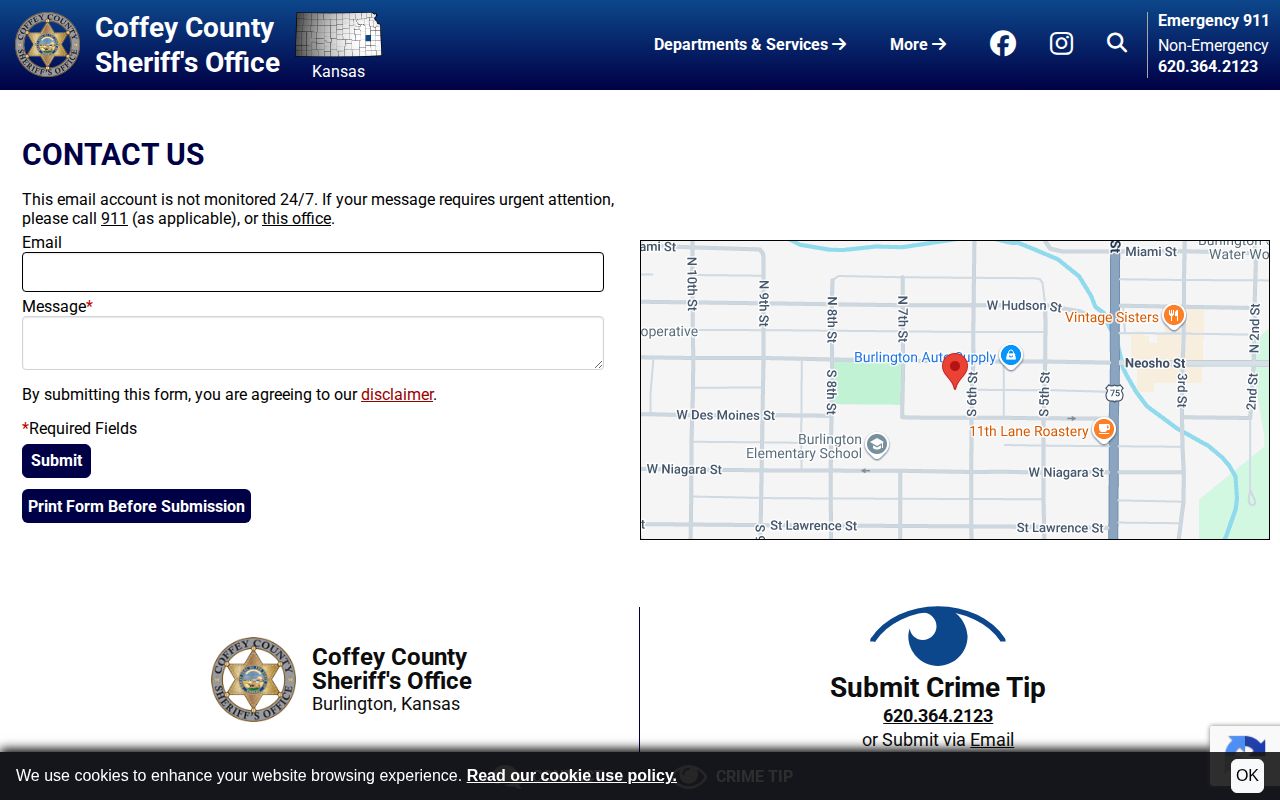
Use the jail line for live custody facts and the records route for a document. The two channels answer different questions.
Reconcile Coffey County Release Times
Three records can carry three related times. The court order can show when release was authorized. The jail record can show when physical processing ended. A receiving agency can show when a transfer was accepted. These entries may differ without one being false.
When timing matters, preserve each record with its source and access date. Ask the custodian about the underlying document instead of choosing the most convenient timestamp. The sheriff itself disclaims certification of the public web display's accuracy or authenticity, so the card is best treated as a recent-event indicator. A custodian-produced release sheet or certified court copy is stronger proof.
No fixed retention period for Coffey County release sheets was verified. The 48-hour web window is not a destruction schedule. It describes public display time only, which is why a focused request remains the correct route for the missing third day and for older events.