
Coffey County Release Records
Release from the Coffey County Sheriff's Office Kansas Detention Center means that the sheriff ended that booking's custody. It does not always mean the person entered the community. A person may have posted bond, received a court-ordered release, finished a county term, moved to probation, or transferred to another agency. The sheriff's recorded release time proves a departure from that custodian. The release sheet and court order explain more.
A transfer to the Kansas Department of Corrections, another county, federal custody, or immigration custody remains a custody event. State prison release is different again. KDOC may classify a person as on parole, postrelease supervision, conditional release, or discharged. Each label has its own meaning. A discharge ends the KDOC sentence or supervision shown in that record, but it does not settle an unrelated case or hold.
- Bond
- Pretrial release under financial or other court conditions. The case continues.
- Time served
- Custody credit or confinement satisfies the ordered jail term. Another case or supervision may remain.
- Probation
- Court-ordered community supervision, often used instead of more confinement.
- Parole
- Supervised community release from an eligible prison sentence after a board decision.
- Discharge
- Completion or termination of the sentence or supervision reflected in the named system.
Coffey County Release Types
The wording attached to a Coffey County release determines the next place to check. Never infer a reason from how long someone stayed or from a bond amount. The public sheriff card does not show a release-reason or destination field. A call to the jail or a request for the release sheet is needed when that fact matters.
| Exit event | Meaning | Next record |
|---|---|---|
| Bond or recognizance | County detention ends while the case remains open. | Bond order and district-court docket |
| Dismissal or court order | The court supplies legal authority for release. | Journal entry, dismissal, or release order |
| Time served | The ordered county term or credited time is met. | Sentence and jail calculation |
| Probation | Custody gives way to court supervision. | Probation order and supervising office |
| KDOC transfer | The person leaves the county jail but stays confined. | KASPER state offender record |
| Federal or ICE transfer | Another government takes custody. | BOP, federal court, USMS, or ICE records |
A hold can also end while a second authority keeps the person. Death terminates custody but must not be described as community release. Those distinctions matter when family, counsel, or a victim needs to know where the person went.
Coffey County Release Record Fields
The official Coffey County released list publishes a useful but limited record. Its cards show a name, booking number, age, booking date and time, release date and time, charges, and a profile link. The profile observed during research also showed gender, race, arresting agency, and added charge detail. It did not show a booking image, release reason, destination, or bond.
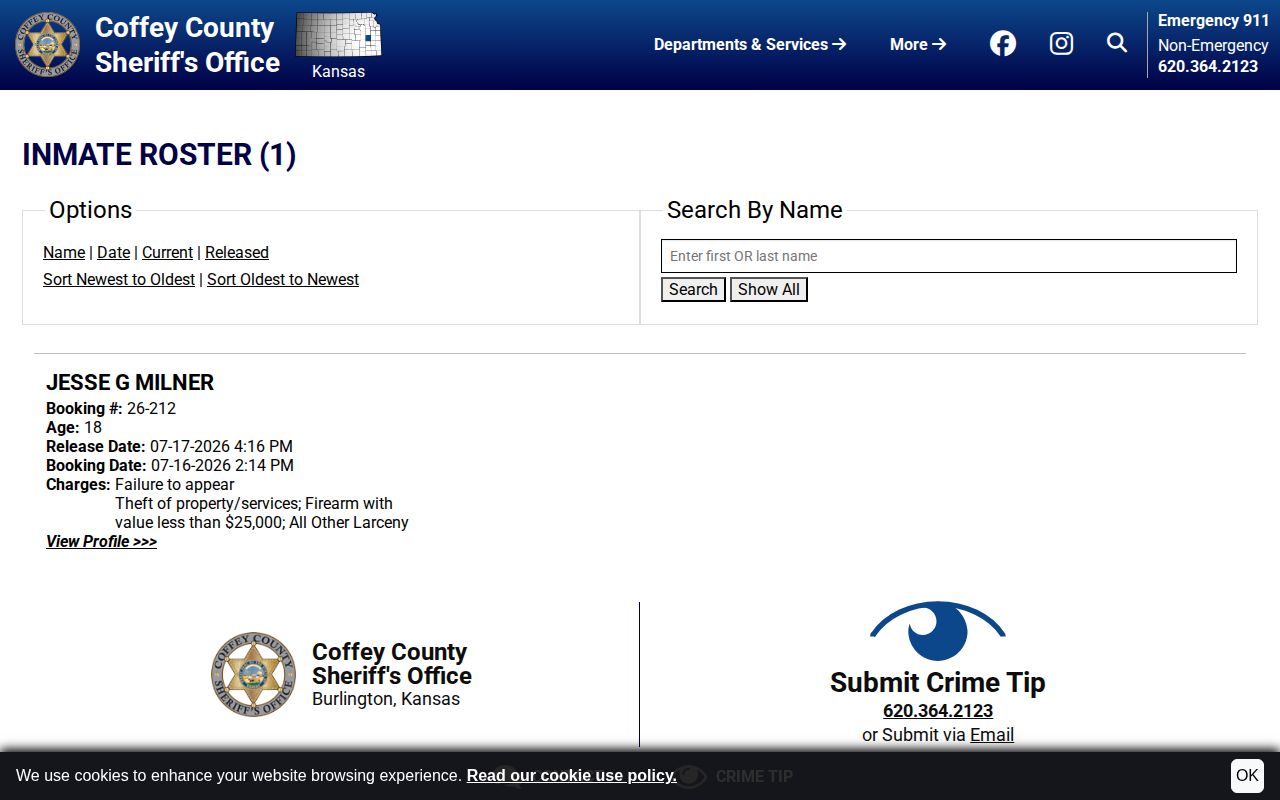
The captured list reflects the public fields available from the sheriff. Underlying jail records may contain more detail, but access can depend on the record and applicable exemptions.
| Field | What it shows |
|---|---|
| Booking number | The identifier that ties the release to one jail booking. |
| Booking timestamp | When that custody episode was entered. |
| Release timestamp | When the sheriff recorded departure from its custody. |
| Charges | The booking allegations, not proof of conviction. |
| Release authority or type | Why custody ended, if maintained and publicly available. |
| Destination | A receiving agency or other destination, if recorded and public. |
Request Coffey County Release Records
Once the 48-hour card expires, use the sheriff's records-request instructions and electronic form. Ask for existing documents and fields. A narrow request is easier to locate and price than a broad demand for every record. Include the full name, known aliases, date of birth if appropriate, booking number if known, and a tight booking and release date range.
- Identify the booking. Save the name, booking number, charges, and approximate dates.
- Name the records. Request the booking sheet, release sheet, movement or custody-status log, bond or release authority, destination if maintained and public, and booking photograph if needed.
- Choose electronic copies. Ask for a cost estimate before chargeable work begins.
- Submit through the official form. The sheriff says it will email for authorization before completing work when a fee applies.
- Compare the response with the court record. Ask the custodian about any conflicting field instead of changing its meaning.
The sheriff's electronic request form creates a trackable description of the records sought.
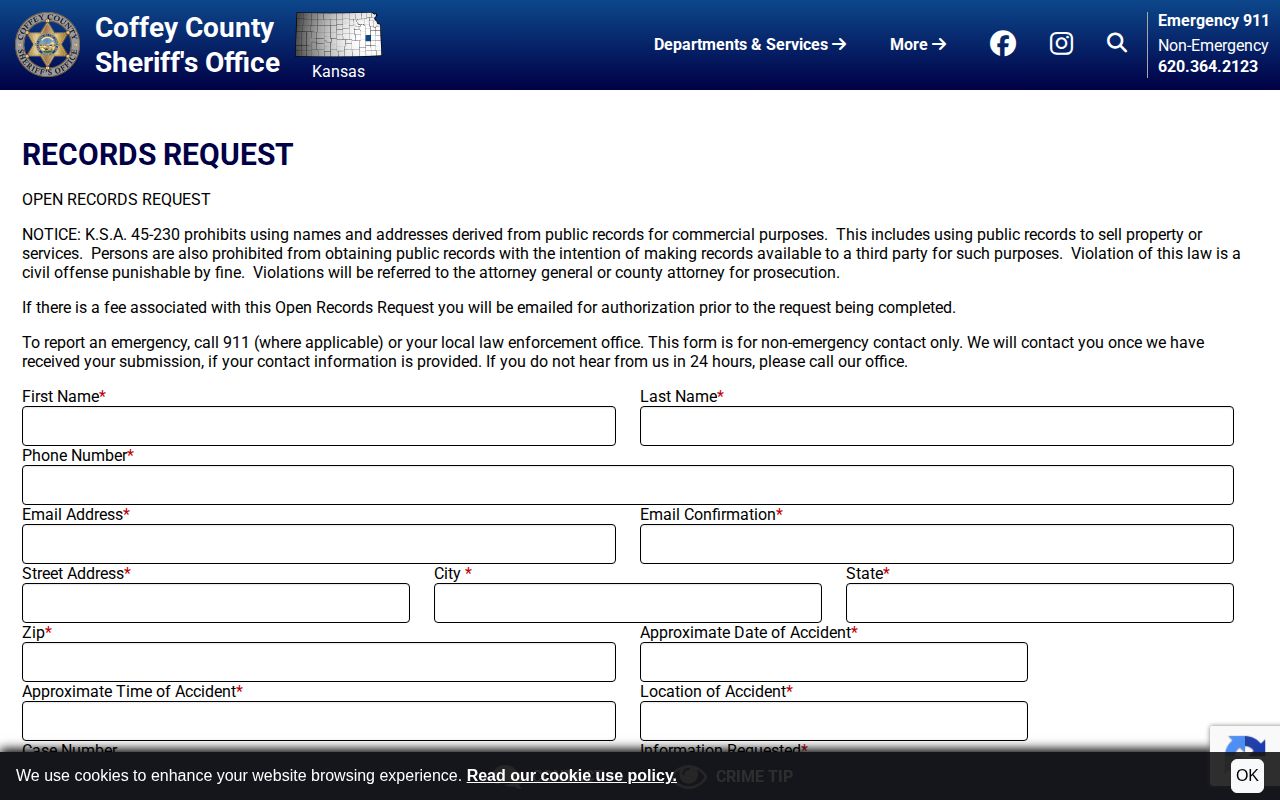
That form is the direct route for an older Coffey County release record after the public card has rolled off.
Correct Coffey County Release Records
An expired card does not end the verification path. Describe the exact field believed to be wrong, the value that should replace it, and the document that supports the correction. Include the booking number, dates, and the live URL or a saved copy of the card. Request the release sheet first. It gives the records custodian a concrete source to compare.
The fee-preauthorization step helps keep the request controlled. Coffey County lists some report-copy prices, including $2.50 for digital reports, $2 by mail, and $15 on DVD, but those items are not a guaranteed total for every open-records request. Staff time and other actual costs may apply. Let the custodian quote the specific work before authorizing it.
Coffey County Release Record Law
The Kansas Open Records Act, K.S.A. 45-215 through 45-250, governs access to agency records. K.S.A. 45-218 covers inspection and copies, while K.S.A. 45-219 allows applicable fees. K.S.A. 45-221 lists records that may be closed. The Kansas Attorney General explains that an agency must act on a request as soon as possible and no later than the end of the third business day. That is a response deadline, not a promise that all records will be produced within three days.
K.S.A. 45-217 excludes jail rosters, court records, and police blotter entries from its definition of criminal-investigation records. That supports access to those public record categories, but it does not open every internal field. Juvenile, sealed, expunged, medical, security, and other protected data may be withheld or redacted. Ask for the segregable public part and the legal basis for any denial.
No official schedule establishing one Coffey County retention term for release sheets or booking photographs was found. The sheriff's 48-hour web display is not a destruction schedule. Ask the records custodian which approved schedule governs the underlying document.
Coffey County Bond Release
Coffey County publishes a District Court-approved bonding-agent list through December 31, 2026, updated April 8, 2026. It is a navigation source, not an endorsement. The jail directs callers to 620-364-3199 for current bail, charge, and case-number accuracy.
Bond ends the immediate detention under that booking. It does not dismiss the case. The district-court docket may later show hearings, a plea, trial, sentence, revocation, or dismissal. Use the sheriff timestamp for physical departure and the court order for the authority and terms.
Find Coffey County Released Inmates
Start with the last known custodian. Recent county jail releases may still appear in the official 48-hour view. A person who entered state custody belongs in KASPER. Court records explain the legal event, while VINE supports future notifications. Federal tools apply only when federal facts exist.
- Check the sheriff's current inmate view and 48-hour release view. Match the name with booking number, age, dates, and charge context.
- If the card is gone, call the jail or request a release sheet. Absence from both lists proves nothing by itself.
- Search KASPER when a felony sentence or transfer to KDOC is likely. Read the exact custody, supervision, and discharge labels.
- Search the Coffey County district-court case for bond, disposition, sentence, probation, dismissal, revocation, or satisfaction orders.
- Use BOP, federal court, USMS, or ICE only when a record points to that authority.
The 24-Hour Releases path explains how to filter the county's actual 48-hour feed. For a future state-prison date, use the Release Date Lookup.
Coffey County 48-Hour Releases
Coffey County's exact official product is called “48 Hour Release.” No separate sheriff 24-hour or 72-hour feed was verified. The gateway says it contains all persons released from the detention center within the prior 48 hours. Cards may be sorted, searched by name, and opened for more booking detail. The sheriff does not publish a refresh schedule or promise how soon a completed release will appear.
The official roster gateway states the window and carries the sheriff's accuracy disclaimer.
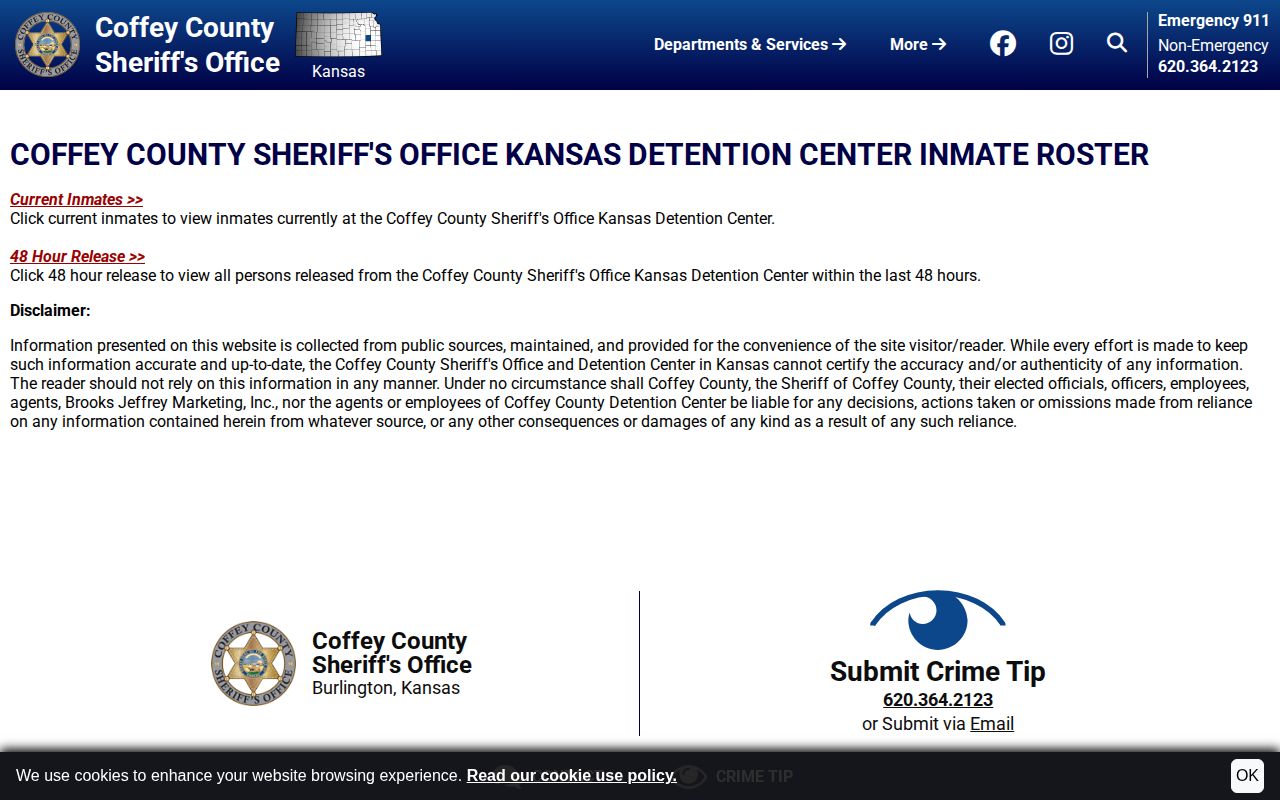
This gateway is the best first check for a very recent county jail exit. For anything older, a date-bounded log or named release-sheet request closes the gap.
Coffey County KDOC Release Search
KASPER, the Kansas Adult Supervised Population Electronic Repository, is the official KDOC lookup. It covers state custody, state supervision, and historical KDOC records within its public scope. It is not a county booking archive. Someone held only in the Coffey County jail may never appear there.
Use a KDOC number when known. Otherwise search by name, inspect candidate records, and compare the date of birth and physical identifiers. Review current status and location or supervision first. Then read sentence records and dates. Copy labels exactly because “parole eligibility,” “conditional release,” “projected,” and “discharge” do not mean the same thing.
| Search or result field | How to use it |
|---|---|
| KDOC number | Most exact public search key when known. |
| Name | Starting point that requires identity comparison. |
| Current status | Distinguishes prison, community supervision, or discharge. |
| Facility or supervision | Shows the KDOC institution or community status presented. |
| Sentence and dates | Must be read under the interface's exact labels. |
| Photograph | Helps compare identity but does not prove current custody. |
The KASPER search screen is the correct state route after a documented KDOC transfer or prison release.
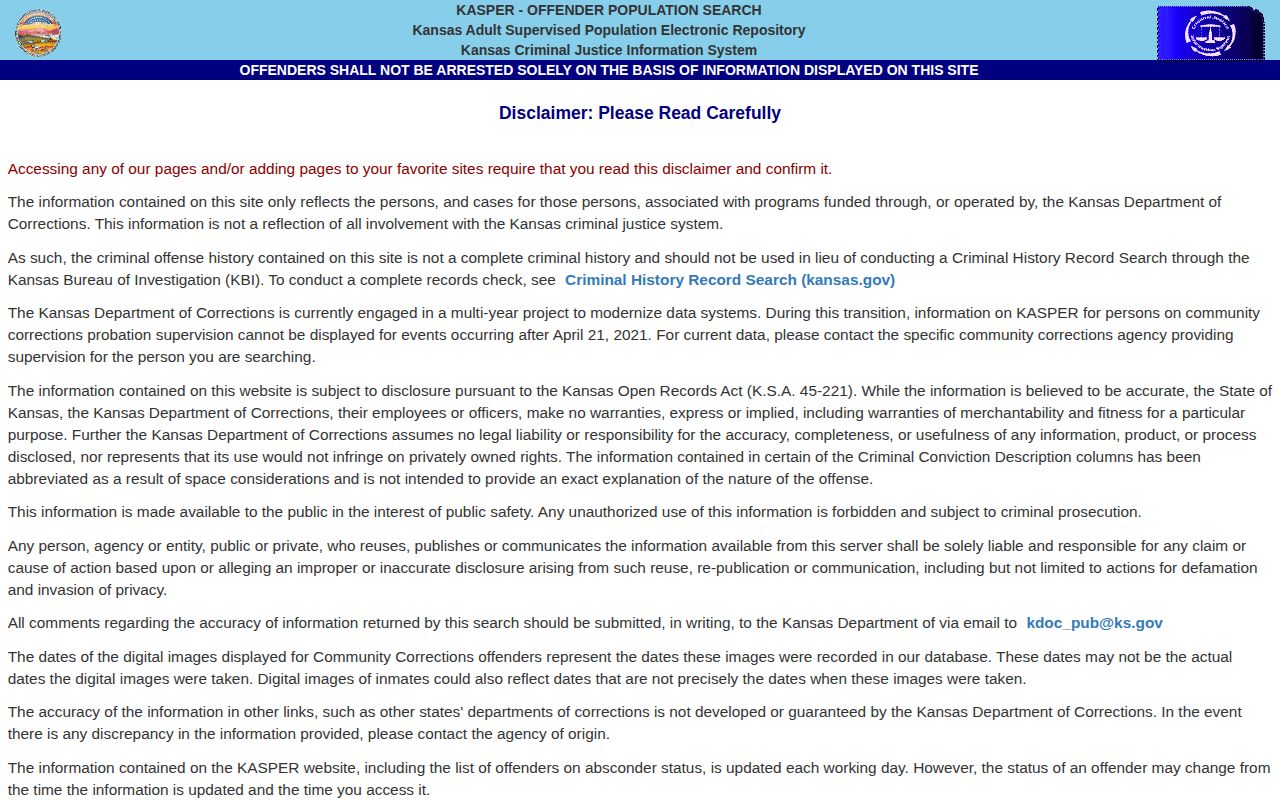
A status of parole or postrelease supervision means prison custody ended but KDOC supervision remains. “Discharged” addresses the KDOC record, not every possible new or unrelated custody matter.
Coffey County Release Court Records
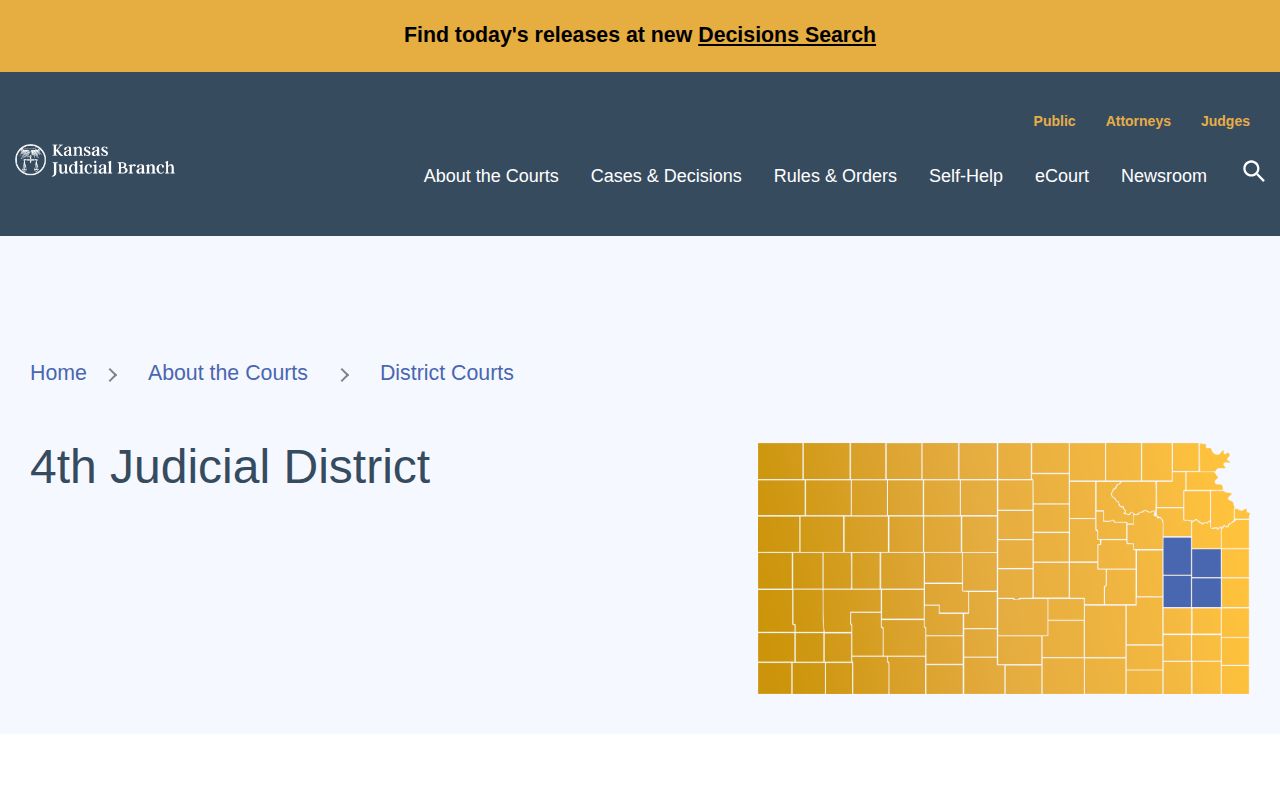
Coffey County belongs to Kansas's Fourth Judicial District. The jail records the physical exit timestamp, while the court records the authority behind it. That pairing matters because the sheriff's public release card does not show a release reason. Search the Kansas district-court portal for the Coffey County case, then locate the bond order, dismissal, sentencing journal entry, probation order, revocation, warrant, or satisfaction event.
K.S.A. 22-3426 requires covered judgment records to state the charge, plea or verdict, judgment, and sentence. Covered felony entries also identify sentence terms, supervision duration, concurrent or consecutive structure, incarceration credit, and county jail imposed as a probation condition. Those details help distinguish time served, probation, and commitment. They do not replace the sheriff's physical release time.
The Fourth Judicial District source confirms Coffey County's court assignment.
Online docket text may be brief. Ask the clerk for the filed order when the exact terms control, and remember that sealed, expunged, juvenile, or restricted cases may not produce a public portal result.
Coffey County Post-Release Supervision
Three supervision paths may follow a Coffey County release. KDOC Community and Field Services handles parole and postrelease supervision. Court services or community corrections may supervise probation. The Kansas Prisoner Review Board makes parole decisions for eligible cases, but a grant still requires release processing and resolution of any detainer.
Use KASPER to identify the reported state status and supervising information. For probation, read the signed Coffey County court order and contact the listed supervising office. An absconder label reports an alleged failure to remain in contact or comply. It is not proof of a new conviction or the person's current location. More detail appears under Post-Release Supervision.
Coffey County Release Locator Paths
Kansas VINE supports custody-event notifications through VINELink. Search for the specific person and matching custodian, then register for the channels offered by that agency. Alerts can lag and are not certified records. The VINE Inmate Check explains one-person searches and alert confirmation. The KBI registry is separate and applies only to people legally required to register, not to all Coffey County released inmates.
For a federal sentence, the BOP Inmate Locator accepts a BOP, DCDC, FBI, or INS number, or name with biographical filters. A historical result may show “Released” and a date. “Not in BOP custody” does not rule out USMS pretrial custody, a local contract bed, ICE, state custody, or community supervision.
ICE's locator is mainly a current-detention tool. Use it only when a detainer, destination field, federal filing, or another credible record points to immigration custody. No ICE facility or detention contract was verified in Coffey County.
Where Coffey County Releases Appear
Choose the source by custody type and time. No single database covers every Coffey County release.
| System | Best use | Key limit |
|---|---|---|
| Current jail roster | Confirm current Coffey County detention | A released person normally drops off |
| 48-hour release view | Confirm a recent sheriff-recorded exit time | Short display; no reason or destination |
| Sheriff release sheet | Document an older county release | Requires a focused request |
| KASPER | Check KDOC custody, supervision, or discharge | Not every county-only booking appears |
| District court | Find legal authority and disposition | May not show physical exit time |
| BOP locator | Check a sentenced federal prisoner | Does not cover all federal custody |
Transportation After Coffey County Release
Coffey County Public Transportation is a general option that a released resident or family may arrange in advance. The service is based at 520 Cross Street and can be reached at 620-364-1935. County information describes lift-equipped vehicles and eligibility for county residents.
Trips are first-come, first-served and generally should be arranged 24 hours ahead. Same-day service depends on availability. No official source says the jail schedules the ride or that a vehicle waits at the release door. Confirm the pickup point and time with dispatch before relying on it.
Coffey County Release Record Offices
The newer Coffey County Law Enforcement Center sits just west of the courthouse. It houses the Sheriff's Office, Emergency Dispatch, County Attorney, and jail functions. That proximity can make a sheriff and court cross-check practical, but the offices do not share one merged record.
The sheriff holds the booking and physical release record. The district court holds the orders and case chronology. Request each document from its own custodian, then preserve both timestamps when they differ.
Coffey County Release Facilities
Five local or serving systems can matter. Only the county detention center operates the verified Coffey County public release feed. The other pages explain where their records begin and end.
- Coffey County Sheriff's Office Kansas Detention Center: county custody, 48-hour release cards, and sheriff release sheets.
- Kansas Department of Corrections adult correctional facilities: statewide prison, supervision, and discharge records through KASPER.
- Coffey County District Court, Fourth Judicial District: bond, disposition, sentence, probation, and later orders.
- Federal Bureau of Prisons institutions nationwide: federal sentence and release-date lookup.
- ICE detention / locator system: a limited current-custody path when immigration facts support it.