
KDOC Releases From Coffey Cases
The Kansas Department of Corrections is a statewide prison and supervision system. It is not the Coffey County jail, and no KDOC adult institution was verified inside the county. A person sentenced in Coffey County District Court may leave the local detention center for KDOC intake. That first departure is a transfer, not a community release.
Later KDOC outcomes can include parole, mandatory postrelease supervision, conditional release, discharge, or another transfer. Parole and postrelease supervision both allow a person to live outside prison under state control, but they arise under different sentence rules. Discharge means the controlling KDOC sentence or supervision status has ended as recorded. Each term must be copied from the official record rather than replaced by the generic word “released.”
| Status path | What it means for the search |
|---|---|
| County jail to KDOC | Custody continues in the state system; check KASPER after intake. |
| In a KDOC institution | The person remains in state prison custody. |
| Parole or postrelease | The person is in the community under KDOC supervision. |
| Conditional release | A statutory state release status whose precise record controls. |
| Discharged | The KDOC record reports the state sentence or supervision endpoint. |
Search KDOC Coffey Release Records
KASPER, the Kansas Adult Supervised Population Electronic Repository, is the official KDOC public lookup. It covers people in state custody or supervision and historical records within its scope. It is not a county-booking archive. A short Coffey County detention that never becomes KDOC custody may produce no KASPER record.
- Search by KDOC number when known because names can change or match.
- Otherwise search by name and compare birth date and physical identifiers.
- Open the matching result and copy the KDOC number, current status, facility or supervision location, sentence data, and each date label exactly.
- Separate a prison location from a parole or postrelease field and from a discharge entry.
- For a disputed computation or missing document, contact KDOC Records with a narrow request.
KASPER date labels vary with sentence type and history. A sentence-begins date, parole eligibility date, conditional release date, projected date, and discharge date are not interchangeable. Preserve the label and access date. The Coffey County release search should be used instead when the person only left the local jail.
Note: A no-result search can reflect spelling, identity, timing, or scope and does not prove freedom from all custody.
KDOC Coffey Offender Search Fields
KASPER can provide identifying information, KDOC number, current status, facility or supervision information, convictions and sentences, and a KDOC photograph where available. KDOC materials also identify sentence-related data such as the controlling sentence and sentence-begins date. Readers should compare several identifiers before accepting a match.
| Field | Release-record use |
|---|---|
| KDOC number | The strongest public key for one state offender record. |
| Current status | Distinguishes prison custody, community supervision, or another recorded state condition. |
| Facility or supervision location | Shows which KDOC institution or field structure has responsibility. |
| Conviction and sentence | Connects the state record to the Coffey County judgment when applicable. |
| Date labels | Must be read literally; eligibility, projection, release, and discharge answer different questions. |
| Photograph and identifiers | Help confirm the match but may not appear on every record. |
The KDOC offender-locating page explains the state record route and available offender information.

The state source is the right place for a person who actually entered KDOC custody, while sheriff and court files remain necessary for the earlier Coffey County episode.
KDOC Release Dates After Coffey
Kansas law does not support one universal rule that every state prisoner serves the same fraction. K.S.A. 21-6821 caps ordinary good-time subtraction at 15 percent for many crimes committed on or after July 1, 1993, if credit is earned and retained. Specified lower-severity crimes in stated periods can have a 20 percent maximum. Older, off-grid, mandatory-minimum, consecutive, and specialized sentences require separate analysis.
A sound reading starts with the signed Coffey County journal entry: offense date, severity or off-grid status, prison term, concurrent or consecutive order, jail credit, and postrelease term. KDOC then applies controlling-sentence rules, good-time credit, forfeiture or restoration, eligible program credit, detainers, and later court orders. A projected prison exit can change without changing the original sentence text.
Parole eligibility is not a release promise. The Prisoner Review Board can parole, continue, or pass an eligible case under the rules that apply. Even a grant does not establish the physical exit date because release planning, conditions, detainers, rescission, or another authority can intervene. Confirm the later status in KASPER and seek the action notice when needed.
KDOC Coffey Supervision After Release
Coffey County supervision questions can involve KDOC parole or postrelease supervision, district-court probation, or community corrections. The jail charge does not identify the supervising structure. Use KASPER and the court order. KDOC geographically routes Coffey County parole matters to the Lawrence Parole Office.
- Parole
- Conditional community release for a sentence governed by parole rules and Board action.
- Postrelease supervision
- A required community-control term following the prison portion of many guideline sentences.
- Probation
- A court-ordered alternative or sentence status supervised through the judicial or community structure, not automatically KDOC parole.
- Absconder
- A reported failure to remain in contact or comply with supervision; verify the current status through the responsible authority.
KDOC publishes separate parole and community-corrections absconder searches. An explicit result reports a supervision status. It is not proof of the alleged violation, a new conviction, or the person's current physical location. KDOC warns users not to arrest anyone solely from website information.
KDOC Coffey Discharge Records
Use KASPER before submitting a Kansas Open Records Act request. If the needed movement, release, discharge, or sentence-computation document is not public there, make a narrow request to the KDOC records custodian. Identify the offender by full name, KDOC number, date of birth if appropriate, and the exact record and date range sought.
A request can seek the named offender's movement or release record, discharge record, sentence-computation record to the extent public, or a releasable offender photograph. Ask for existing records rather than a new legal calculation. Public access can be limited by governing law, exemptions, and redactions.
714 SW Jackson, Suite 300
Topeka, KS 66603
General: 785-296-3317
Records Division: 785-746-7470
Email: KDOC_Pub@ks.gov
Lawrence Parole Office: 785-842-2926
The KDOC contacts page shows agency and records routes used for follow-up beyond KASPER.

Do not send a county-jail-only request to KDOC unless the person entered state custody. The sheriff owns the local booking and release sheet.
Note: Copy the exact KASPER status and lookup date before asking KDOC to reconcile a disputed state release record.
KDOC Facilities Serving Coffey Cases
No Kansas adult prison was identified inside Coffey County. That negative finding does not mean a Coffey County sentence cannot result in state imprisonment. It means the state facility should not be presented as a local release counter or confused with the Burlington county jail.
The KDOC facilities and community-office directory identifies institutions and field offices across Kansas.
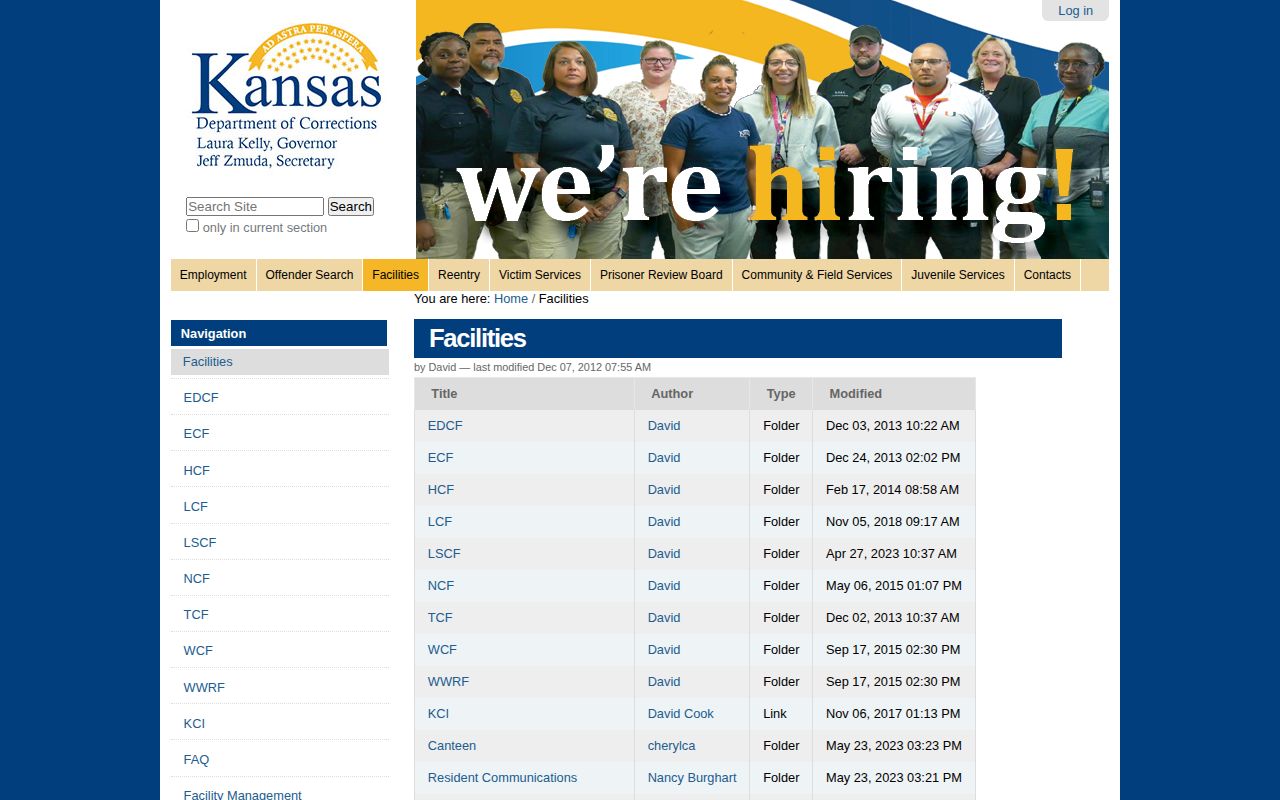
Use the facility shown in the current KASPER record, not the county of conviction, to determine the institution responsible for a present custody question. Use the supervising office shown by KDOC for community status.
Reconcile KDOC and Coffey Records
A Coffey County sheriff exit, a district-court commitment, KDOC intake, prison release, supervision start, and final discharge are separate events. Each agency records its own action. The dates can differ without a contradiction. The county timestamp ends local custody; the court order supplies legal authority; KDOC records state custody and supervision.
Preserve every record with its source and access date. If the sheriff sheet names KDOC as destination but KASPER has no prompt result, contact the responsible offices instead of declaring community release. Intake and web publication can lag. Likewise, “discharged” in KDOC does not erase the historical Coffey County case or change the court judgment.
Federal and immigration locators should enter the workflow only when a detainer, destination field, federal filing, or other credible fact supports them. A missing state result alone does not justify guessing a federal transfer.